14x36x4 Air Filters: Can MERV 13 Beat Pet Allergies?
Your golden retriever sheds something invisible long before he sheds his coat. Pet dander particles measure roughly 2.5 microns across, small enough that a basic MERV 8 filter (which only starts catching at 3 microns) lets most of it ride right through your return air. That gap is exactly why a 14x36x4 filter at the wrong MERV rating can leave allergy-prone family members congested in their own house, even with a fresh filter dropped into the slot every 90 days. Stepping up to MERV 13 at this size closes the gap and pulls down the particle sizes that drive cat and dog allergy reactions. It only works if your blower can move air through the denser media. Fixing the problem isn't complicated. It comes down to which MERV rating belongs in your specific HVAC setup, and your blower spec is what answers.
TL;DR Quick Answers
14x36x4 Air Filters
14x36x4 is the nominal name on the box. The actual filter measures 13.5 by 35.5 by 3.63 inches, so it slides into the housing without binding.
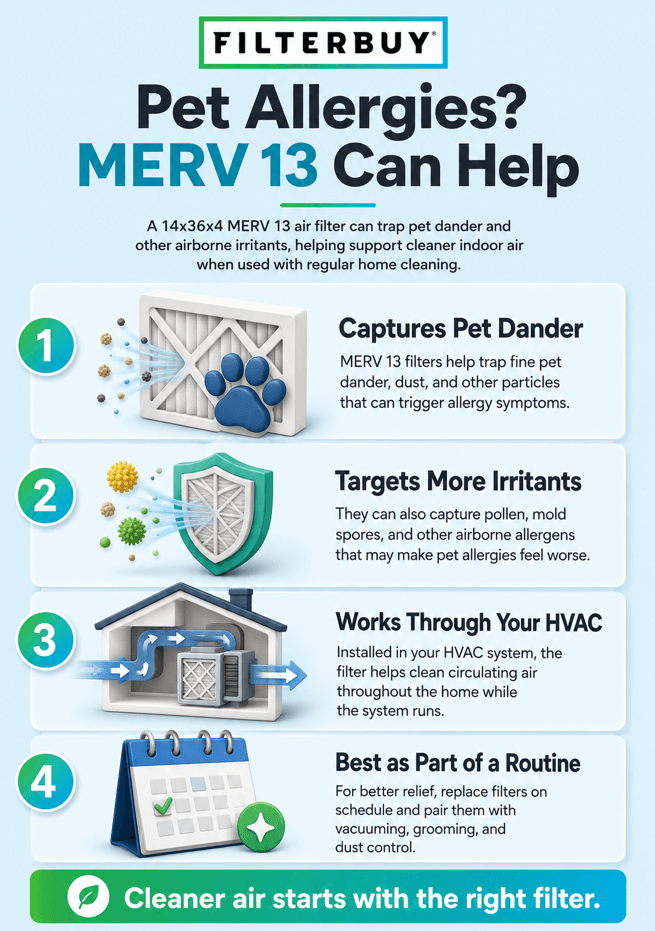
At the same physical size, MERV 13 captures the smaller particles that drive pet allergies. MERV 8 and MERV 11 both miss a meaningful share of pet dander.
Pet homes replace 4-inch filters every 60 to 90 days. The 6-to-12-month interval printed on most boxes assumes no pets and no allergies in the household.
For older or borderline HVAC systems, MERV 11 is the right answer. A higher rating costs you airflow you can't afford to lose.
Check your blower's static-pressure spec before stepping up to MERV 13. If it handles the load, the upgrade is worth the price difference.
Top 5 Takeaways
Pet dander sits mostly at 2.5 microns and below. MERV 13 captures down to 0.3 microns, which is where Fel d 1 and Can f 1 live.
A 4-inch filter holds roughly four times the pleated surface area of a 1-inch filter, so it can handle a higher MERV rating without choking your airflow.
Static pressure is the make-or-break number. If your blower isn't rated for MERV 13's added load, you'll lose airflow and undo the upgrade.
Pet homes change 4-inch filters every 60 to 90 days. Marketing copy that promises a year of service is written for non-pet households.
American-made pleated filters from a single production line deliver the run-to-run consistency allergy-prone homes need. Imports often vary batch to batch.
What A 14x36x4 Air Filter Actually Is (And Its True Size)
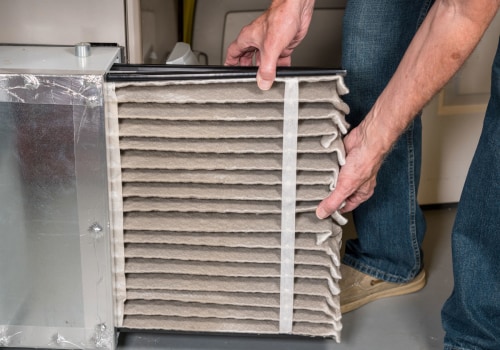
Open your filter slot and try to fit a fresh 14x36x4 inside. You'll notice the math doesn't add up. The filter measures 13.5 x 35.5 x 3.63 inches, not 14 x 36 x 4. That undersize is by design. Filter housings are built with a slip-fit tolerance so the media slides in without binding, and the nominal dimension on the box matches the label on your slot.
The 4-inch depth is where the work gets done. A 1-inch filter at this face size gives you one shallow pleat field. A 4-inch version packs roughly four times the pleated surface area into the same air path. More surface means each square inch of media handles less air, face velocity drops, and small particles have more places to get caught. The added depth also keeps a higher-MERV filter from clogging the way a 1-inch version at the same rating would.
The 14x36x4 shows up in larger central return-air housings, typically in single-family homes with one big return drop. If that describes your setup, you're already positioned for a higher-MERV upgrade because the deeper housing gives the system room to breathe.
If your slot fits a different 4-to-5-inch depth instead, our 20x25x5 air filter walkthrough covers the same logic at a different size.
Pet Dander, Allergens, And The Particle Sizes That Matter
Most pet owners assume the hair on the couch is what triggers the allergy attacks. It isn't. The actual trigger is dander, microscopic skin flakes the animal sheds constantly, plus saliva and urine proteins that dry and aerosolize. Cat allergens specifically (Fel d 1) are smaller and stickier than dog dander, which is why cat homes often feel worse for allergy sufferers even when the cat seems tidier than the dog.
Most pet dander particles sit at 2.5 microns and below. For comparison, a human hair runs 50 to 70 microns thick. We're working with particles 20 to 30 times smaller than what you can see floating in a beam of morning light. Those are the particles a MERV 8 filter at any size struggles to catch. MERV 8 only captures down to roughly 3 microns at moderate efficiency, which means a meaningful share of pet dander slips through and keeps recirculating.
The job of an air filter is to physically intercept these particles as air passes through pleated media. Higher MERV ratings use denser fibers and more efficient capture geometry. MERV 13 is where residential filtration starts, seriously addressing the 0.3 to 1 micron range, which is where the finest dander, smoke, and bacterial carriers live.
For a pet home with an allergy sufferer in the family, MERV 11 is the entry point, and MERV 13 is the upgrade. MERV 8 isn't enough on its own.
MERV 13 Vs MERV 11 Vs MERV 8 At The 14x36x4 Size
Choosing between these three MERV ratings at the same physical size comes down to what your HVAC system can handle and what your household breathes day in and day out.
MERV 8 At 14x36x4
Captures particles roughly 3 to 10 microns.
Best for pollen, dust mite debris, lint, and larger household dust.
Low airflow resistance, easy on older systems.
Not enough on its own for pet-dander allergies.
MERV 11 At 14x36x4
Captures particles roughly 1 to 3 microns.
Catches pet dander, mold spores, and fine dust.
Moderate airflow resistance that most residential blowers handle without issue.
The most common upgrade pick for homes with one pet or mild allergy.
MERV 13 At 14x36x4
Captures particles down to 0.3 microns at meaningful efficiency.
Catches the finest dander, smoke particles, and virus-carrying droplets.
Higher static pressure load requires a capable blower.
The right answer for allergy-prone homes with newer or properly sized HVAC equipment.
Static pressure is the question most homeowners skip. Open the cabinet door on your air handler and look at the blower spec on the label inside. A blower rated for high external static pressure can handle MERV 13. An older or weaker blower will see airflow drop measurably, and lower airflow undoes the upgrade you just paid for. If you aren't sure where your system stands, have an HVAC tech put a manometer on it before you commit.
Buying And Replacing A 14x36x4 MERV 13 In A Pet Home
A 4-inch pleated filter at MERV 13 isn't a generic shelf decision, and the filter you grab in a hurry isn't the same one that ships from a manufacturer that controls its own production line.
What To Look For Before You Buy
High pleat count per linear inch. More pleats give you more capture surface and longer service life between changes.
A rigid beverage-board frame that stays square under static pressure. Cheap cardboard frames bow under load and let air bypass the media around the edges.
A MERV rating verified to ASHRAE Standard 52.2, not a marketing number printed on the carton.
U.S. manufacturing has consistent media density, so the filter you order in month three performs the same as the one you ordered in month one.
Multi-pack pricing in 2-pack or 4-pack formats, matched to the cadence pet homes need.
After manufacturing filters for over a decade and serving more than two million households, we engineer our 4-inch pleated lineup specifically to hold airflow while pulling down the smaller particles thrown at the system. We test every media run before it goes into a frame, because consistency of the media is what protects allergy-prone households over time.
How Often To Replace In A Pet Home
Single pet, light shed: every 90 days.
Two or more pets, or one heavy shedder: every 60 days.
Severe allergies during peak shed season: every 45 to 60 days.
You'll know it's time when the intake face shows visible hair matting, when the media goes gray to brown in color, or when you start seeing dust drift around vents downstream of the filter. Don't wait for an HVAC tech to point it out at the next maintenance call.

"For pet households, the harder question isn't whether MERV 13 captures pet dander, because it absolutely does. The question is whether your HVAC system can move air through that denser media without losing pressure, which is exactly what we engineer our 4-inch pleated lineup to handle."
Essential Resources
After narrowing in on MERV 13 14x36x4 air filters for a pet home, these seven independent sources give you the science, standards, and certification context that turn a filter purchase into an informed decision.
1. Learn What's Floating Through Your Indoor Air
Most homeowners can't see what's circulating in their air, and the EPA's introduction to indoor air quality lays out which pollutants belong on your radar. Useful baseline reading before you decide which MERV rating fits your household.
Source: EPA Introduction to Indoor Air Quality
2. See The Allergy Science Behind Living With Cats And Dogs
The American Academy of Allergy, Asthma & Immunology walks through what's happening at the protein level when a pet allergy sufferer reacts. Fel d 1, Can f 1, and the carrier proteins your filter is fighting all live on this page.
Source: AAAAI Pet Allergy Symptoms, Diagnosis, Treatment & Management
3. Find Allergy-Certified Products That Pass Independent Testing
AAFA's Certified Asthma & Allergy Friendly program tests household products through independent labs against scientific standards. Their Certification page explains what the mark means and how the testing works in practice.
Source: AAFA Certified Asthma & Allergy Friendly Program
4. Keep Your AC Running Strong While Filtering Harder
A denser filter makes your blower work harder, so the rest of the system has to keep up. The Department of Energy's maintenance guide covers coil care, refrigerant checks, and the airflow basics that keep MERV 13 from costing you more in energy than it saves you in dander.
Source: DOE Air Conditioner Maintenance Guide
5. Understand The MERV Rating Standard From The Source
MERV isn't a marketing acronym. ASHRAE wrote Standard 52.2 and the position document on filtration and air cleaning that defines how filters get rated and what each rating delivers in the field.
Source: ASHRAE Position Document on Filtration and Air Cleaning
6. Get Filter Guidance From The Air Filtration Trade Association
The National Air Filtration Association represents the people who build and test the filters you're shopping for. Their residential air filtration overview walks through filter specs, MERV levels, and the airflow trade-offs homeowners usually miss.
Source: NAFA Residential Air Filtration Overview
7. Read Peer-Reviewed Research On Indoor Air Filtration
This peer-reviewed study sampled 22 bedrooms with and without air filtration and measured how filtration shifts airborne cat, dog, and dust mite allergen levels by particle size. It's the kind of empirical research that backs the case for upgrading MERV in a pet home.
Source: NIH PMC Study on Air Filtration and House Dust Mite, Cat, and Dog Allergens
Supporting Statistics
Three independent data points that frame why a higher-MERV 14x36x4 matters in a pet-owning household.
1. About 1 In 4 U.S. Adults Reports A Seasonal Allergy
CDC's latest National Health Interview Survey data puts seasonal allergy prevalence at about 1 in 4 U.S. adults, with 31.7% reporting any allergic condition. That's a meaningful slice of every South Florida household where pet dander stacks on top of outdoor pollen as a year-round indoor trigger.
Source: CDC FastStats on Allergies and Hay Fever
2. Indoor Air Can Be 2 To 5 Times More Polluted Than Outdoor Air
The American Lung Association reports that indoor air pollutant levels typically run 2 to 5 times higher than outdoor levels, and in some cases up to 100 times higher. The air you're trying to clean inside is dirtier than the air outside your front door.
Source: American Lung Association Clean Air Indoors
3. U.S. Households Own About 87 Million Dogs And 76 Million Cats
AVMA's 2025 Pet Ownership and Demographics Sourcebook tracks roughly 87 million dogs and 76 million cats across U.S. households, with dog ownership at about 45% of households and cat ownership at about 29%. Every system cycle pulls all that shed dander into your return air.
Source: AVMA U.S. Pet Ownership Statistics
Final Thoughts And Opinion
After years of swapping filters in Florida pet homes and watching the static-pressure numbers come back from the equipment, here's where I land. A MERV 13 14x36x4 is the right answer for most pet households where someone has allergies, as long as the blower can move air through it. Treating MERV like a horsepower number is the most common mistake we see. A clogged or undersized MERV 13 underperforms a clean MERV 11 in a system that can't push air through the denser media.
A short field-tested framework:
Newer HVAC equipment rated for high external static pressure: jump to MERV 13 and don't look back.
Older system or one already running hot on airflow: stay at MERV 11 and tighten your replacement cadence instead.
Either rating: a 4-inch depth at 14x36x4 buys you more filtration life and steadier capture than any 1-inch filter on the market.
Once you've had a 4-inch pleated filter in your return, the 1-inch versions feel like a temporary fix. That part isn't closed.
Frequently Asked Questions
Q: Is a 14x36x4 air filter the same as a 13.5x35.5x3.63 air filter?
A: Yes. 14x36x4 is the nominal size printed on the box. 13.5 x 35.5 x 3.63 is the actual measured dimension. Manufacturers print the nominal size so it matches the label on your filter slot, and the slightly smaller actual size lets the filter slide into the housing without binding. Both numbers describe the same filter.
Q: Will a MERV 13 14x36x4 filter strain my HVAC system?
A: It depends entirely on your blower. MERV 13 adds more static pressure than MERV 8 or MERV 11 because the media is denser. Newer residential systems and properly sized blowers handle the added load without breaking a sweat. Older systems, or ones already running high static pressure, can see airflow drop noticeably, reducing filtration effectiveness in practice. Have a tech measure static pressure before you commit if you aren't sure where your system stands.
Q: How often should I replace a 14x36x4 filter if I have two dogs and a cat?
A: Every 60 days is the right starting point for a three-pet household. If anyone in the home has allergies, tighten that to 45 to 60 days during peak shed season. Pull the filter at the 30-day mark and look at the intake face. Visible hair matting or a gray-to-brown discoloration tells you your shed rate is high, and your cadence should be shorter than 60 days.
Q: Is MERV 13 worth it if I already use a HEPA portable air purifier?
A: Yes, because the two solve different problems. A portable HEPA cleans one room. A MERV 13 in your HVAC return cleans the air in every room every time the system runs, which is constantly during a Florida summer. The two work together, and the MERV 13 keeps pet dander from cycling through your ductwork in the first place.
Q: Are there 14x36x4 air filters made in the USA?
A: Yes. We manufacture our 14x36x4 pleated lineup in the United States with consistent media density and rigid beverage-board frames. American manufacturing matters here because filter media performance depends on consistency from one production run to the next, which is harder to control with overseas sourcing and longer supply chains.
Q: Can I buy 14x36x4 air filters in a multi-pack?
A: Yes. 2-packs and 4-packs are the common formats, and the multi-pack pricing matches the 60 to 90-day replacement cadence pet homes need. A 4-pack locks in a year of filter changes for a single-pet household, or about six months for a multi-pet one.
Make The Air Match The Household
Choose the 14x36x4 MERV 13 that matches your blower and your household, and your HVAC system starts catching the pet dander your family shouldn't be breathing. Shop our U.S.-made 4-inch pleated lineup or talk to our team about which MERV rating fits your specific setup.
Learn more about HVAC Care from one of our HVAC solutions branches…
Filterbuy HVAC Solutions - West Palm Beach FL
1655 Palm Beach Lakes Blvd., Ste 1005 West Palm Beach, FL 33401
(561) 448-3760
https://maps.app.goo.gl/VarpgNZnxuPQuW8A7